Between the day you sign and the day you close, the title company does a lot of work you can't see. Here's what happens, what the title commitment actually says, and what you can do to keep your deal on track.
Module 5: Contract to closeAbout 13 min readFree course
On a wholesale deal, you open title the day you sign by sending the contract and your earnest money to the title company. They search the records and send a title commitment: Schedule A names the deal, B-I lists what has to happen before closing, and B-II lists what the policy won't cover. Once B-I is handled, you're clear to close.
Lesson
17 of 19, module 5: Contract to close
Time
About 13 minutes to read
You'll need
Your signed contract, your title company and the seller's contact details
Next
Lesson 18: closing day
The short answer
What does the title company do on a wholesale deal?
The title company's job is to make sure the seller can actually sell the house, and that your buyer gets it free of surprises. They search the public records, find what's attached to the property, tell everyone what has to be fixed, and then close the deal and pay everyone.
On a wholesale deal, that work runs in the background while you find your buyer. That's why you open title the day you sign. If there's a lien, a missing heir or ten years of unpaid water bills, you want to know in week one, not the day before closing.
In some states an attorney does this job, or supervises it. Everything in this lesson still applies. Quick note: I'm a real estate investor, not an attorney or financial advisor. This lesson is education, not legal advice.
Open title
You send the signed contract, the earnest money and every party's details. The file and the search start.
The commitment
The title company sends what it found and what it needs, in three parts: Schedule A, B-I and B-II.
Clearing title
Liens get paid off, judgments get released, and missing paperwork gets signed or filed.
Clear to close
Every requirement is handled or will be at closing, and any lender has signed off. Now you can schedule closing.
Start to finish
The wholesale title process at a glance
Stage
What the title company does
What you do
Open title
Opens a file and orders the search
Send the contract, the earnest money and the parties the day you sign
Search
Checks owners, liens, judgments, taxes and recorded documents
Find your buyer and answer title's questions fast
Commitment
Sends Schedule A, B-I requirements and B-II exceptions
Read it the day it arrives and flag problems
Curative work
Orders payoffs, releases and missing documents
Help reach the seller, heirs or lienholders
Clear to close
Confirms every requirement is handled
Lock in the closing date with the seller and buyer
Step by step
How the wholesale title process works, step by step
1
Step 1: Open title the day you sign
As soon as the seller signs, send the contract to the title company you named in it. When to open title varies by company, but I open it right away. The search takes time, and every day you wait is a day your buyer is waiting too. Lesson 6 covers finding a title company that knows wholesale deals.
Send everything in one clean email: the signed purchase agreement, the seller's name, phone and email, the property address, your contact details and how you'll close. If you've already signed an assignment, send that too, and tell them the buyer's name and how they're paying.
Ask your closer what else they need. Some want a copy of the seller's ID or the payoff details for the mortgage right away. The faster they have it, the faster the search starts.
Checklist
Signed contract sent the day you sign
Seller, buyer and your contact details included
Your plan: assignment or double close
2
Step 2: Get your earnest money in and get a receipt
Your earnest money goes to the title company or closing attorney, not the seller. They hold it in escrow until closing. Get it in before your contract's deadline and ask for a receipt. A missing deposit is an easy way for a seller to cancel.
Know when you get it back, and when you can lose it. Your contract's inspection period sets most of that. Some states add their own rules for wholesale deals: in Missouri, if you skip the required disclosure, the seller can cancel any time before closing and gets your earnest money, Pennsylvania lets the seller cancel, and Oregon gives 3 business days. Louisiana has deposit rules for wholesale contracts too.
When you assign, your buyer usually puts down their own deposit with the same title company. Ask how both deposits will show on the settlement statement.
Checklist
Deposit in before the deadline
A receipt from the title company
Your state's cancel rules checked
3
Step 3: Read the title commitment the day it arrives
The title commitment is the title company's promise to issue a policy once its requirements are met. The standard ALTA commitment form ↗ has three parts.
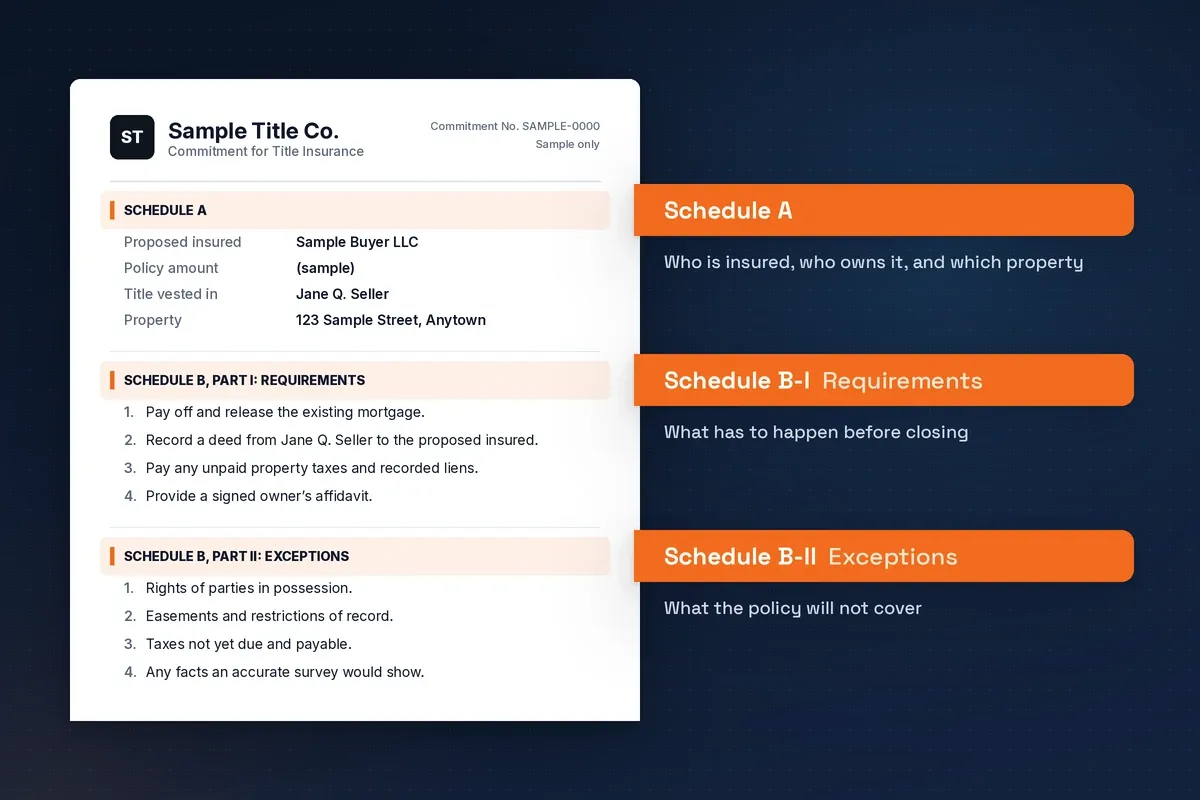
Schedule A is the deal: the effective date, the policies they'll issue, who will be insured and the legal description of the land. Schedule B-I is the to-do list: the requirements that must be met before the policy issues, like paying off a mortgage or recording a release. Schedule B-II is the list of exceptions: things the policy won't cover, like recorded easements.
Read B-I line by line. Every item is something that has to happen before you close. If one of them is big, like a lien larger than your fee, you need to know now. The table below breaks it down.
Commitment checklist
Schedule A: the right property, buyer and policies
Every B-I requirement listed with who handles it
B-II exceptions your buyer should know about
4
Step 4: Work the problems title finds
Distressed houses come with problems. That's part of why the seller is selling. Liens, judgments, unpaid property taxes, code fines, probate and missing heirs usually show up as B-I requirements, things like a payoff, a release or a court order. Some show up as B-II exceptions instead.
This is called curative work. The title company does most of it, but you can help a lot. You have the relationship with the seller. Help them find old paperwork, get heirs on the phone and sign what's needed. On an inherited house, the estate may need to go through probate before anyone can sign.
If a problem costs more than the deal can carry, talk to the title company and an attorney before you do anything else. Sometimes the numbers still work after you renegotiate. Sometimes they don't, and that's what your inspection period is for.
Checklist
Each problem matched to who fixes it
The seller helping with paperwork
The numbers rerun if a lien changes them
5
Step 5: Order payoffs and releases early
Every mortgage, lien and judgment that gets paid at closing needs a payoff statement from the lender or lienholder, good through the closing date. The title company orders them, and they can take a while. Ask your closer when they were ordered and follow up.
After closing, the lienholder records a release showing the debt is paid. The title company tracks that. If a seller says a lien was paid years ago but no release was recorded, title will need proof or a recorded release before closing.
Checklist
Payoffs ordered for every lien
Old paid liens with proof or a release
6
Step 6: Tell title about every party and how you're closing
Requirement 1 on the standard commitment says the person being insured has to tell the title company about anyone not named "who will obtain an interest in the Land or who will make a loan." The title company can then add requirements or exceptions. So tell them early: your end buyer, a transactional lender, an LLC buyer, everyone.
Who gets insured depends on how you close. In an assignment, your end buyer is usually the proposed insured. In a double close, there are two deals, and there may be two commitments. Stewart Title's Utah rate manual requires two separate commitments, each charged independently. An LLC sale raises its own title questions, and Lesson 16 covers them.
Checklist
Every party named to the title company
Your closing method confirmed with title
7
Step 7: Get to clear to close
Clear to close isn't a legal term. It means the title company's B-I requirements are met or will be met at closing, and if your buyer has a lender, the lender has approved too. Once your closer says you're clear, schedule closing with the seller and your buyer.
Watch the clock. The standard commitment form ends if the policy isn't issued within 180 days of the commitment date, and some states change that. A wholesale deal shouldn't take that long, but a stuck probate can.
Lesson 18 picks up from here: closing day, signing, wires and how you get paid.
Checklist
Every B-I item marked done or due at closing
Lender approval, if your buyer has a loan
Closing date set with everyone
Or get your license. In these states, a real estate license may be the cleanest path. That's Oklahoma, Illinois, Virginia, Minnesota, South Carolina, Kentucky and Nebraska, where the closing method doesn't change the rule. Colibri Real Estate School ↗ has pre-licensing courses for each of them. Heads up: I earn a commission if you buy through my link. Costs you nothing extra, but it helps fund my Starbucks addiction. ☕
Reading it
Title commitment explained: Schedule A, B-I and B-II
Here's what each part of the standard commitment says, and what to look for on a wholesale deal.
Part
What it is
What to look for
Schedule A
The effective date, the policies to be issued, the proposed insured and the land
The right property, the right buyer and the right policies for how you're closing
Schedule B-I, requirements
What must happen before the policy issues
Payoffs, releases, signatures, probate papers and anything about you or your buyer
Schedule B-II, exceptions
What the policy won't cover
Easements, survey issues or old problems your buyer should know about
Conditions
The rules of the commitment
It ends if no policy issues within 180 days, and the company may amend it
Ask your closer to walk you through anything you don't understand. A good one will. And send a copy to your buyer, because they're the one being insured.
Distressed deals
Common title problems on wholesale deals
This is how commitments typically handle the problems that come with distressed houses. Every file is different, so your closer has the final word.
Problem
Usually shows up as
What usually clears it
Mortgage or home equity loan
B-I: payoff and release
Paid from the closing funds, release recorded after
Judgment against the seller
B-I: payoff or release
Paid at closing, or released by the creditor
Unpaid property taxes
B-I: payment
Paid at closing
Code or utility liens
B-I: payoff
Payoff letter from the city, paid at closing
Owner passed away
B-I: probate or heir documents
A court appointment, or every heir signs
Old lien already paid
B-I: release needed
The lender records a release, or title accepts proof
Easement or survey issue
B-II: exception
Usually stays. Tell your buyer.
Who gets insured
Owner's and lender's policies by closing method
An owner's policy protects the buyer. A lender's policy protects the lender. How you close changes who's on the commitment.
Method
Who's usually insured
What to ask title
Assignment
Your end buyer, and their lender if they have one
Does the commitment name my buyer once I assign?
Double close
You on the first deal, your buyer on the second. Often two commitments.
Same as a double close. Your lender is a party too.
What does my lender need from you?
LLC sale
Unclear when the LLC holds only a contract
Can my buyer get the coverage they expect?
Who closes
Which states require an attorney at closing?
In some states, an attorney has to handle or supervise parts of the closing. I'm only naming the ones I've checked against the source.
Delaware: the state's Supreme Court has held that attorneys must conduct or supervise real estate closings (ODC digest ↗).
Massachusetts:c. 221, section 46E ↗ reserves tasks like directing a closing and managing the disbursement of the money to Massachusetts attorneys. The section is written around closings that use communication technology, so ask a local attorney how it applies to yours.
Georgia and South Carolina:Lesson 6 covers how closings work there.
Everywhere else: it varies, and practice can change by county. Ask a local investor or attorney who usually closes cash deals.
Does the method change the analysis?
Title and your closing method
Short version: tell title about every party, expect a double close to mean two title orders, and know that Utah requires separate funds for each closing and that an FHA buyer can't take an assignment. Your closing method also doesn't change the license rules in states like Oklahoma, Illinois and Virginia.
Lesson 16 has the full state-by-state table, and the laws by state page has every state's rules.
On paper
Reading a made-up title commitment
Simplified illustration with a made-up house and made-up numbers, not typical results. Every commitment is different.
Simplified illustration
What title found on an inherited house
You signed a contract with the daughter of the late owner and opened title the same day. Here's the B-I list that came back.
B-I requirement
Made-up amount
Who handles it
Payoff of the mortgage
$42,000
Title orders the payoff, paid at closing
Unpaid property taxes
$3,100
Paid at closing
City water lien
$1,250
Title gets a payoff letter from the city
Probate: court appointment of the daughter
n/a
The seller's probate attorney
Signatures of the other two heirs
n/a
You help the seller reach them
Nothing here kills the deal, but probate sets the timeline. Tell your buyer up front, and don't promise a closing date until the court appointment is done.
Simplified illustration
When a lien is bigger than the deal
Same house, but title also finds a judgment against the late owner.
Item
Made-up amount
Your contract price
$95,000
Liens and taxes from the first list
$46,350
New judgment found
$38,000
Left for the seller before their costs
$10,650
The seller may not be able to sell at this price. Talk to title and an attorney. Sometimes a creditor settles, sometimes the numbers change, and sometimes the deal ends in your inspection period.
Avoid these
Title mistakes to avoid
Waiting to open title
Send the contract the day you sign. Problems take time to fix.
Not reading the commitment
B-I is your to-do list. If you don't read it, you'll find out at closing.
Leaving parties out
Tell title about your buyer, any lender and any LLC buyer. Surprises get new requirements.
Promising a closing date too early
Probate, payoffs and missing heirs set the timeline. Wait until you're close to clear.
Wiring money from an email
Confirm wiring instructions by phone, using a number you already know.
Asking title for legal advice
They can explain the commitment, not your rights. That's a job for an attorney.
Recap
Lesson recap
Open title the day you sign: the contract, the earnest money and every party's details.
Schedule A is the deal, B-I is what must happen before closing, and B-II is what the policy won't cover.
Liens, judgments, taxes and probate are normal on distressed deals. Find them early and help clear them.
Tell title about every party and how you're closing. A double close often means two orders.
Clear to close means the requirements are handled. Then set the closing date.
Before your first closing. Title, closing and wholesaling rules vary by state and change often. Check the laws by state where the property is, and have a local real estate attorney answer any legal questions.
See the whole Wholesaling University course free
Enter your name and email to read the rest of this lesson and every lesson in the course.
The full text of every lesson, opened on this device
Every step, worked example and checklist
My free Wholesale Deal Analyzer (Excel)
I couldn't find your sign-up on this device. Enter your email again and the course opens right away. You won't be signed up twice.
Unlocked. You're signed up, so every Wholesaling University lesson is open in full on this device.
Tools
Tools I use for this
Two free resources from me, and the lesson that covers how your closing method changes the title work.
Free
Wholesaling laws by state
The wholesaling rules where the property is, with links to the state's own sources.
Practice varies by title company, but most wholesalers open title right after the purchase contract is signed. Send the contract, your earnest money and every party's contact details the same day. The search takes time, and you want to find liens or missing heirs early. Ask your title company what they need.
What's the difference between Schedule B-I and B-II?
Schedule B-I lists the requirements, the things that must happen before the title policy issues, like paying off a mortgage or recording a release. Schedule B-II lists the exceptions, the things the policy won't cover, like recorded easements. B-I is your to-do list. B-II is what your buyer should know about.
How long is a title commitment good for?
The standard ALTA commitment form says the commitment ends if the policy isn't issued within 180 days of the commitment date. Some states change that wording, so check yours. Most wholesale deals close well before then, but probate or a hard-to-reach lienholder can slow things down.
What if title finds a lien bigger than my spread?
The deal may not work as written. Talk to your title company and an attorney first. Sometimes a creditor settles, sometimes you and the seller renegotiate, and sometimes the deal ends during your inspection period. Don't pressure the seller, and don't promise your buyer anything until you know.
Does the end buyer get the title policy in an assignment?
Usually, yes. In an assignment, your end buyer is normally the proposed insured on the owner's policy, and their lender gets a lender's policy if they have a loan. Confirm with your title company once you assign, so the commitment names the right buyer.
Does a double close need two title orders?
Often, yes. A double close is two deals, so many title companies open two files. Stewart Title's Utah rate manual requires two separate commitments with two escrows, each charged independently. Ask your title company how they handle it and what each order costs.
Do I need an attorney to close a wholesale deal?
In some states, yes. Delaware requires attorneys to conduct or supervise closings, and Massachusetts reserves some closing tasks to attorneys. Other states vary, and practice can change by county. Ask a local investor or attorney who usually closes cash deals where the property is.
Why does title want to know about my transactional lender?
Requirement 1 on the standard commitment says you have to tell the title company about anyone not named who will get an interest in the property or make a loan. A transactional lender makes a loan, so title needs to know and may add requirements. Tell them early.
Next: lesson 18, Closing day: how a wholesale deal closes
Heads up: I earn a commission if you buy through my link. Costs you nothing extra, but it helps fund my Starbucks addiction. ☕
Not legal advice. Confirm with a licensed attorney in your state.
Not financial or legal advice. Wholesaling University is for education. David Frizzell is a real estate investor, not an attorney or financial advisor. Wholesaling laws vary by state, so check the rules in your state before you market a property or make offers, and talk to a local real estate attorney if you're not sure.
Free download
Free wholesaling contract pack
Wholesaling contract templates, free. Enter your email and the pack lands in your inbox.
Check your email for your wholesaling contract pack
It's on its way to . If it isn't in your inbox in a few minutes, check spam or promotions.