Wholesaling University · Lesson 12 of 19

Maximum allowable offer (MAO): the formula, the 70% rule and examples

Work out the most you can pay a seller and still leave room for your buyer's profit and your fee, before you make the offer.

Module 4: Running the numbersAbout 10 min readFree course
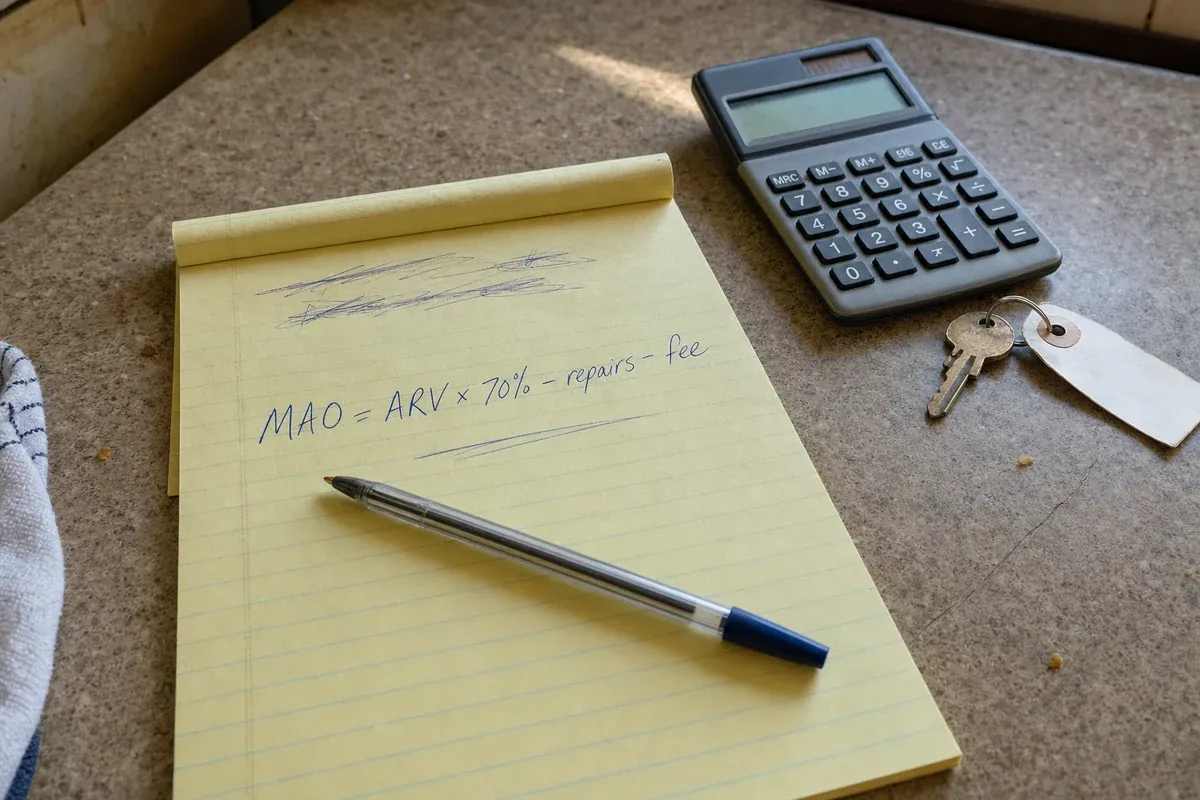
Notepad with the MAO formula written out next to a calculator and house keys
Quick answer

Your maximum allowable offer (MAO) is the most you can pay a seller and still leave room for your buyer's profit and your fee. The common formula is MAO = ARV x 70% - repairs - your assignment fee. The 70% changes by market and by buyer, so confirm what your buyers really pay before you make offers.

Lesson
12 of 19, module 4: Running the numbers
Time
About 10 minutes to read
Formula
ARV x buyer % - repairs - your fee
Free tool
Wholesale Deal Analyzer (Excel)
The basics

A contract isn't a deal

A lot of new wholesalers get excited about getting a house under contract. I get it. But a contract isn't a deal. A deal is a contract at a price a cash buyer will actually pay. Your maximum allowable offer (MAO) is how you make sure you sign the second kind.

MAO is the most you can pay the seller. It's not your offer. You'll open lower and negotiate (lesson 13 covers that). MAO is your walk-away line: go over it and the deal stops working for your buyer, which means it stops working for you.

You need three numbers first: a solid ARV, a realistic repair estimate, and the percentage of ARV your buyers pay in your market.

ARV

What the house sells for after repairs. Lesson 9.

Repairs

What it costs to get it to that value. Lesson 11.

Buyer %

The share of ARV your buyers will pay, before repairs. Often around 70%, but it varies.

Your fee

Your assignment fee or double-close spread. It comes out of the MAO, not on top of it.

Step by step

How to calculate your maximum allowable offer, step by step

Step 1: Start with a solid ARV

Everything starts with the after repair value. Use 3 to 5 renovated sold comps, average the price per square foot and round down. If you skipped it, go back to lesson 9 first.

Your MAO is only as good as your ARV. A 5% mistake in ARV moves your MAO by more than you'd think (there's an example below).

Checklist
  • ARV from renovated sold comps
  • Comps saved with the deal

Step 2: Estimate the repairs

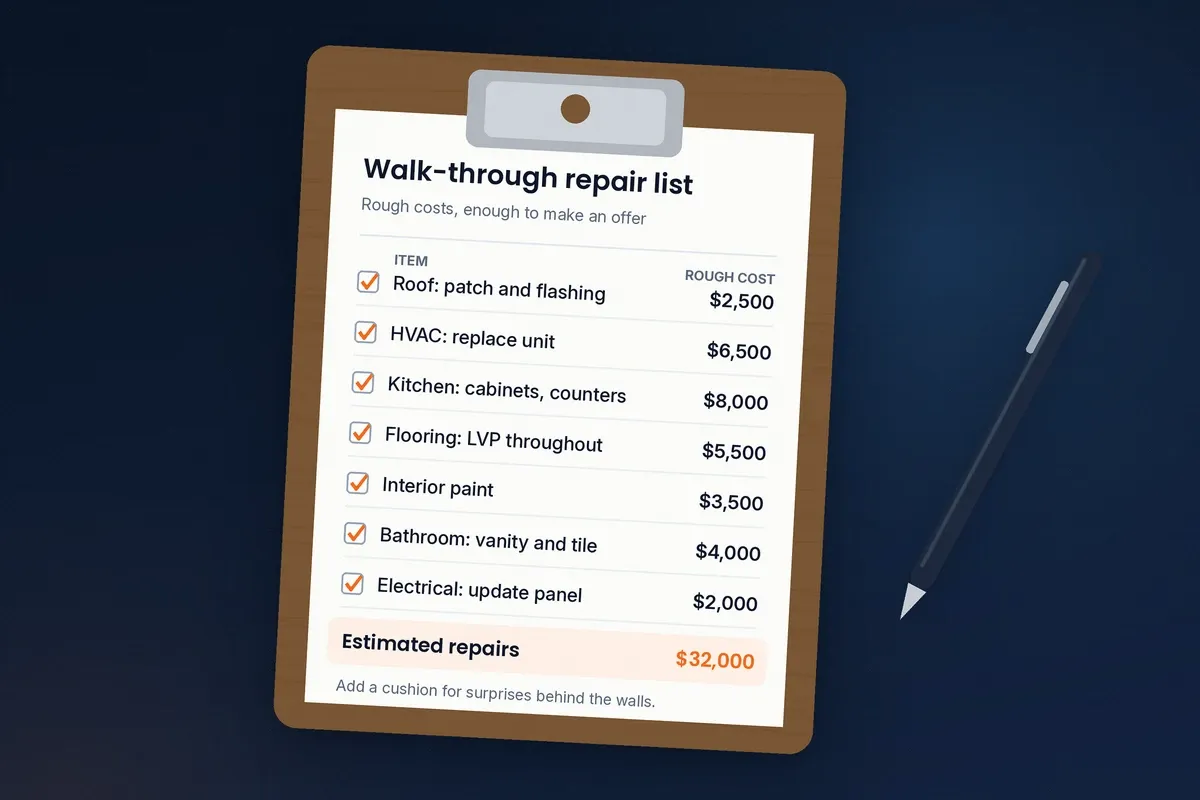
Walk the house and list every repair a buyer will have to make: roof, HVAC, kitchen, baths, flooring, paint, and so on. Put a rough cost next to each. Lesson 11 shows how to estimate rehab costs quickly, and my rehab cheat sheet helps.

Be honest here. Your buyer will walk the house too, and if your repair number is too low, they'll lower their price or walk.

Checklist
  • Repair list from the walk-through
  • A cost next to every item
  • A little extra for surprises
Walk-through repair list on a clipboard with rough costs next to each item

Step 3: Find out what percentage your buyers pay

The 70% rule says an investor should pay no more than 70% of ARV, minus repairs. The other 30% covers their profit, holding costs, closing costs and selling costs. It's a rule of thumb, not a law.

In some markets buyers pay more than 70%, often on higher-priced houses or in busy markets. On cheaper houses they often pay less. The only way to know is to ask your buyers what they paid on their last few deals, and to look at what they sold for.

Checklist
  • Asked 3 buyers what percentage they use
  • Checked a couple of their recent purchases

Step 4: Decide on your fee

Your fee comes out of the deal, not on top of it. Pick a fee that leaves the deal still good for your buyer. A smaller fee on a deal that closes beats a big fee on one that doesn't.

How fees must be disclosed varies by state. Some states require you to tell the seller you're assigning the contract. Check your state's rules.

Step 5: Run the formula

Multiply the ARV by your buyer's percentage, subtract the repairs, then subtract your fee. That's your MAO.

MAO = (ARV x buyer %) - repairs - your fee

Step 6: Check it against your buyer's all-in number

Some buyers don't think in percentages. They tell you, "I'll be all in at this number," meaning purchase price plus repairs. If your buyer gives you an all-in number, work backward: all-in number minus repairs minus your fee.

If the percentage method and the all-in method give you different answers, use the lower one.

MAO = buyer's all-in number - repairs - your fee

Step 7: Set your opening offer and your walk-away

Your opening offer should be below your MAO, so you have room to negotiate. Your MAO is your walk-away. If the seller won't come down to it, thank them, leave the door open and follow up later.

Write all of it down for every lead: ARV, repairs, buyer %, fee, MAO, opening offer. My free Deal Analyzer does it in one sheet.

Examples

Worked examples

These are made-up numbers to show the math. Use your own ARV, repairs and buyer numbers.

Example

The 70% rule

StepMathResult
ARV x 70%$150,000 x 0.70$105,000
Minus repairs$105,000 - $18,000$87,000
Minus your fee$87,000 - $4,000$83,000

In this example the MAO is $83,000. You might open in the low to mid $70,000s and walk away above $83,000.

Example

A buyer's all-in number

StepMathResult
Buyer's all-in numberPurchase plus repairs$45,000
Minus repairs$45,000 - $10,000$35,000
Minus your fee$35,000 - $2,500$32,500

In this example the MAO is $32,500.

Example

What a small ARV mistake does

Take the first example, but say the real ARV is 5% lower: $142,500 instead of $150,000. Now $142,500 x 0.70 = $99,750, minus $18,000 repairs, minus $4,000 fee = $77,750.

A 5% miss on ARV cut the MAO in this example by $5,250. That's why you round ARV down.

Avoid these

Mistakes to avoid

Offering your MAO first

MAO is your ceiling. Open below it so you have room to negotiate.

Using 70% everywhere

Ask your buyers. Your market might be higher or lower.

Lowballing repairs

Your buyer will walk the house. A low repair number only delays the bad news.

Adding your fee on top

The fee comes out of the MAO. Add it on top and your buyer pays too much.

Trusting a rough ARV

Small ARV mistakes make big MAO mistakes. Use good comps and round down.

Chasing a contract at any price

A contract over MAO isn't a deal. No deal is better than a bad deal.

Recap

Lesson recap

  • MAO is the most you can pay, not what you offer.
  • MAO = (ARV x buyer %) - repairs - your fee.
  • The 70% is a rule of thumb. Ask your buyers what they really pay.
  • Check it against your buyer's all-in number and use the lower result.
  • Open below MAO, and walk away above it.

Check your state. Wholesaling laws vary by state, including how you can market a contract and what you have to disclose. Read your state's rules, and ask a local real estate attorney if you're not sure.

See the whole Wholesaling University course free

Enter your name and email to read the rest of this lesson and every lesson in the course.

  • The full text of every lesson, opened on this device
  • Every step, worked example and checklist
  • My free Wholesale Deal Analyzer (Excel)

Free. No credit card. Unsubscribe anytime.

Unlocked. You're signed up, so every Wholesaling University lesson is open in full on this device.
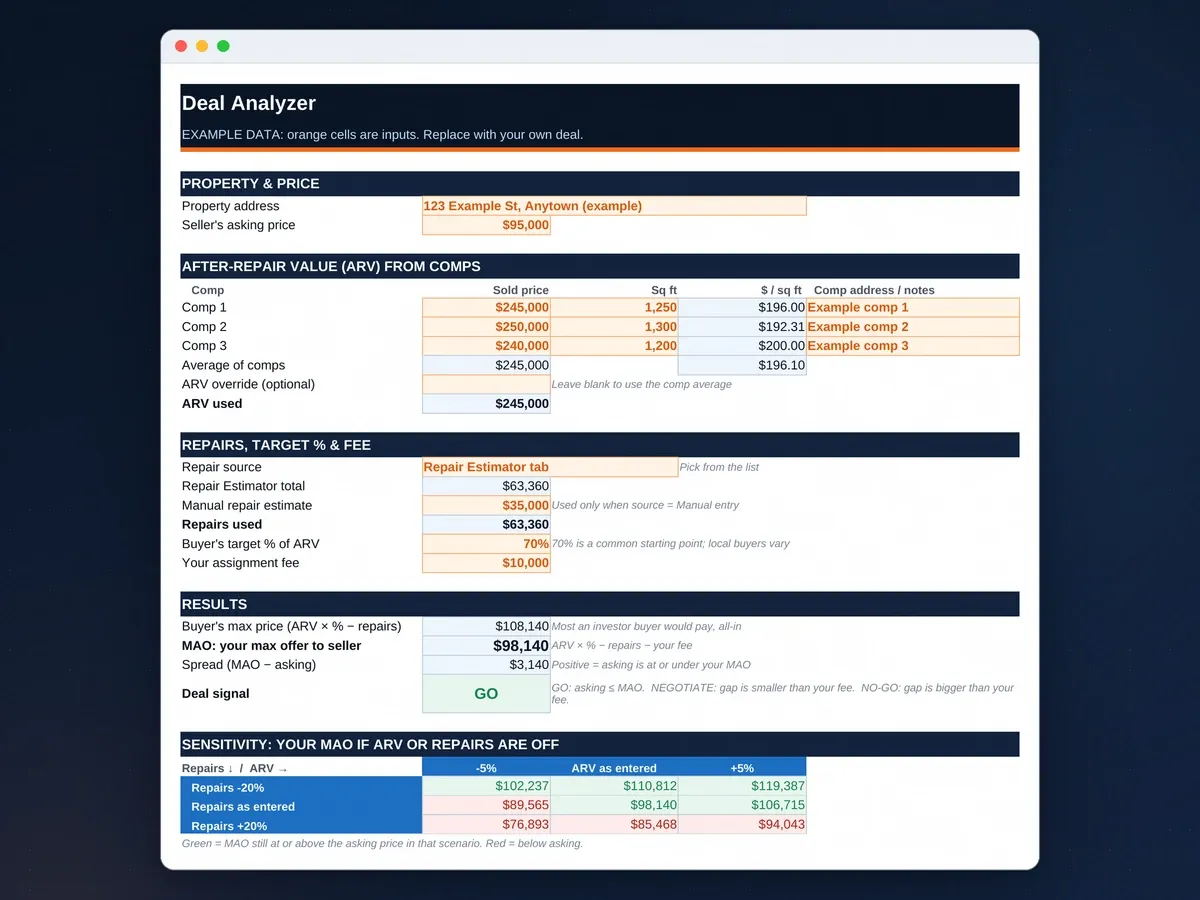
Excel Deal Analyzer tab showing the maximum allowable offer box
Free tool

Run these numbers in my free Wholesale Deal Analyzer

An Excel workbook that takes you from comps to ARV, repairs and your maximum allowable offer in one sheet. Free.

  • Averages up to 3 sold comps into an ARV, with price per square foot
  • Repair estimator with 19 line items
  • MAO = ARV x your buyer's % - repairs - your fee, with a go, negotiate or no-go signal
  • A buyer view and a rental view of the same deal
Get the free Deal Analyzer
FAQ

Lesson 12 FAQ

What does MAO mean in real estate?

MAO stands for maximum allowable offer. It's the highest price you can pay for a property and still leave enough room for repairs, your buyer's profit and costs, and your fee. Wholesalers and flippers figure it out before making an offer, then open below it.

How do you calculate MAO?

Multiply the after repair value (ARV) by the percentage your buyers pay, often around 70%. Subtract the estimated repairs, then subtract your assignment fee. What's left is your MAO. The worked examples on this page walk through the math step by step.

What is the 70% rule in real estate?

The 70% rule says an investor should pay no more than 70% of a property's ARV, minus repairs. The other 30% is meant to cover their profit plus holding, closing and selling costs. It's a rule of thumb. Buyers in some markets pay more or less, so ask yours.

Can I offer more than my MAO?

You can, but then the numbers stop working for your buyer, and the deal usually falls apart or you have to cut your fee. If the seller needs more than your MAO, it's usually better to walk away politely and follow up later. Situations change.

How much should my assignment fee be?

There's no set amount. Your fee has to fit inside the deal and still leave it good for your buyer. Start with what the deal can support after your buyer's numbers. How you have to disclose your fee varies by state, so check your state's rules.

Is there a free MAO calculator?

Yes. My free Wholesale Deal Analyzer is an Excel workbook. Enter your comps, repairs, your buyer's percentage and your fee, and it shows your MAO, the spread against the asking price, and a simple go, negotiate or no-go signal. It opens in Excel and is built to work in Google Sheets too.

Does MAO work for rental buyers?

Yes, but landlords often think in rent and monthly cash flow rather than ARV. Ask a rental buyer what they'd pay for a house like yours, and treat that as their all-in number. Then subtract repairs and your fee to get your MAO.

Next: lesson 13, How to make an offer and negotiate it

Present your number in person, trade on terms and get it signed.

Heads up: I earn a commission if you buy through my link. Costs you nothing extra, but it helps fund my Starbucks addiction. ☕

Not financial or legal advice. Wholesaling University is for education. David Frizzell is a real estate wholesaler, not an attorney or financial advisor. Wholesaling laws vary by state, so check the rules in your state before you market a property or make offers, and talk to a local real estate attorney if you're not sure.

Free download

Free wholesaling contract pack

Wholesaling contract templates, free. Enter your email and the pack lands in your inbox.

Free. Unsubscribe anytime. After you sign up I'll open DealMachine in a new tab.