Wholesaling University · Lesson 14 of 19

Wholesale Contracts and Exit Strategies

The paperwork behind every wholesale deal, the clauses that protect you and your seller, and your honest ways out when a deal won't come together.

Module 5: Contract to closeAbout 14 min readFree course
Wholesale contracts and exit strategies: a purchase agreement with one clause circled in orange next to a second contract, a pen, a phone and a coffee mug
Quick answer

Most wholesale deals use two contracts: a purchase agreement with the seller and an assignment of contract with your cash buyer. The clauses that matter most are the buyer name with "and/or assigns," the earnest money, the inspection period and the closing date. Add your state's required disclosures, plan your exits before you sign, and use them honestly.

Lesson
14 of 19, module 5: Contract to close
Time
About 14 minutes to read
You'll need
Your purchase agreement, your assignment agreement and a local real estate attorney
Next
Lesson 15: marketing your deal to cash buyers
The short answer

What contracts does a wholesaler use?

A wholesale deal is built on contracts. You don't own the house. What you own is the right to buy it under a signed purchase agreement, and that right is what you pass to your cash buyer.

The purchase agreement is your contract with the seller. It sets the price, the earnest money, the inspection period, the closing date and who closes. The assignment of contract is your contract with your cash buyer. It hands them your rights under the purchase agreement in exchange for your assignment fee. Some deals use an option agreement or a joint venture agreement instead or as well.

Your exit strategy is what you'll do if the deal doesn't go as planned: assign it, double close it, bring in a partner, renegotiate or cancel inside your inspection period. Good contracts make those exits clear for everyone. I'm a real estate investor, not an attorney or financial advisor, so have a local attorney review your contracts before you use them.

Purchase agreement

You and the seller. Your right to buy the house.

Assignment of contract

You and your buyer. They take over your right to buy.

Option agreement

The right, not the duty, to buy at a set price for a set time.

Joint venture agreement

You and another wholesaler or investor split one deal.

Read before you sign

The purchase agreement clauses that matter most

Every state's contracts look a little different, but these are the clauses I read on every deal.

ClauseWhat it doesWhat to watch
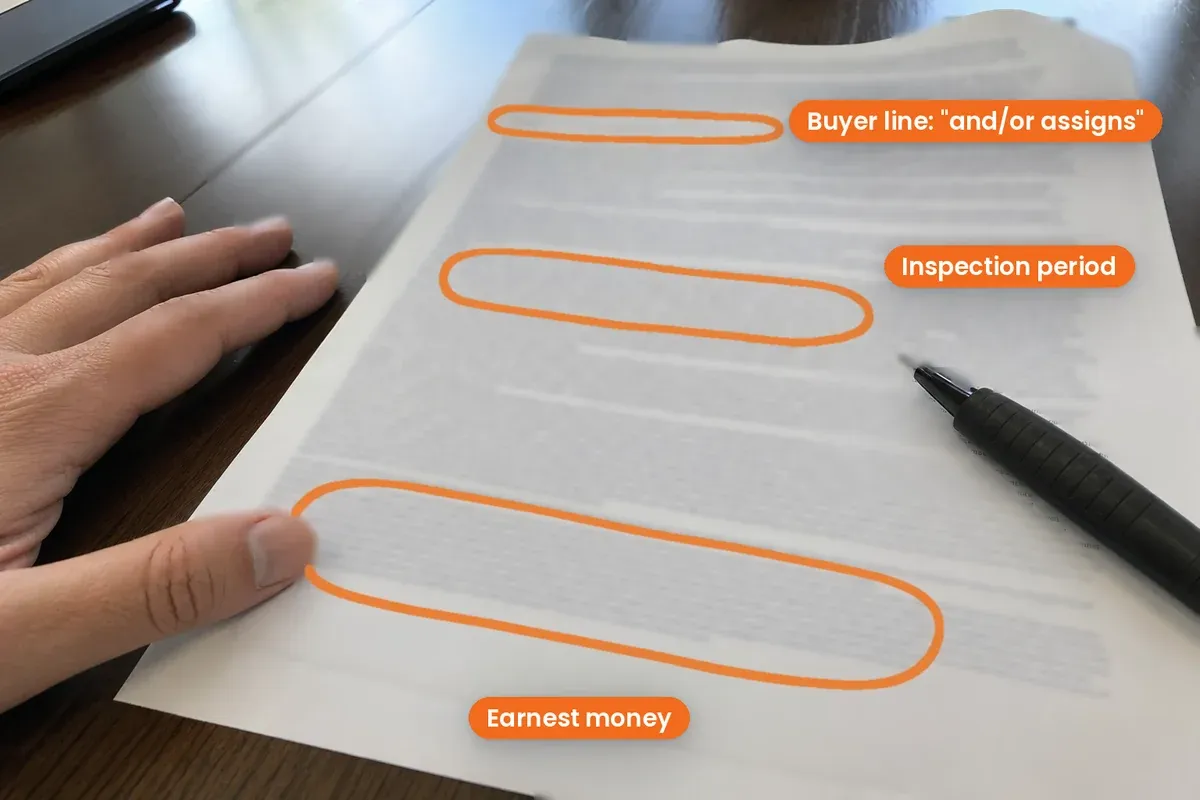
Buyer name "and/or assigns"Lets you assign the contract to someone elseTell the seller what it means, in plain words. Some states require it in writing.
PriceWhat the seller gets for the houseIt should match what you told the seller, with no surprises at closing
Earnest moneyYour good-faith deposit, and who holds itHave the title company or attorney hold it. Note when it becomes non-refundable.
Inspection periodDays you have to inspect and cancelKnow the exact end date and how to cancel in writing
Closing dateWhen the deal has to closeLeave enough time to find a buyer and clear title
Title company or closing attorneyWho closes the dealPick one that closes assignments. See Lesson 6.
AccessLets you show the house to buyers and contractorsWithout it, you can't market the deal well
As-isThe seller makes no repairsDoesn't cancel the seller's required disclosures
State wholesaling disclosuresNotices some states requireUse your state's exact wording and timing
Step by step

How to set up your contracts and exits, step by step

Step 1: Know which contract does what

Before you sign anything, know the job of each document. The purchase agreement ties up the house. The assignment of contract passes your rights to your buyer. If you double close instead, you'll use a second purchase agreement with your buyer. Lesson 16 compares the two.

An option agreement gives you the right, but not the duty, to buy at a set price for a set time, usually for an option fee. Some investors use options on houses that need more time to sell. A joint venture agreement sets out how you and another wholesaler or investor split work and profit on one deal. Get both drafted by an attorney, because they're less standard than a purchase agreement.

Checklist
  • Purchase agreement for the seller
  • Assignment agreement for your buyer
  • Option or JV agreement only when the deal needs it
Step 2: Get the key clauses right

Go through the clauses table above on every contract. The ones that cause the most trouble are the buyer name, the earnest money and the inspection period.

Put your name or your company's name and/or assigns as the buyer, and explain it to the seller in plain words: "This lets me bring in a partner or another buyer to close." Have the earnest money held by the title company or closing attorney, not by you or the seller. And write the inspection period as a clear number of days, with how to cancel in writing.

Add an access clause so you can show the house to buyers and contractors before closing. Without it, your buyers can't see what they're buying.

Checklist
  • Buyer name with "and/or assigns", explained to the seller
  • Earnest money held by title or the closing attorney
  • Inspection period with a clear end and a written cancel process
  • Access for buyers and contractors
Purchase agreement close-up with three spots circled in orange and labeled Buyer line: and/or assigns, Inspection period and Earnest money; the rest of the text is blurred

Step 3: Add your state's disclosures and cancel rights

Check the state table above and Lesson 2. If your state requires a disclosure, use the exact wording and give it at the right time. Some must come before the contract is signed, and Missouri's comes at least 14 days before.

If the seller has a right to cancel, put it in the contract where they'll see it, and plan your marketing around it. A seller in Delaware with a 21-day cancellation right can still back out while you're showing the house. Your buyers need to know that too.

Electronic signatures are fine for most contracts. The federal E-SIGN Act says a contract can't be denied legal effect just because it's electronic. Your title company may still want ink signatures or a notary on some closing documents.

Checklist
  • Your state's disclosure, exact wording
  • Disclosure timing right (before or at signing)
  • Any seller cancel right shown clearly

Step 4: Write the assignment agreement

When you find a buyer, the assignment of contract hands them your rights. It should name you, your buyer and the original purchase agreement, state the assignment fee, and say your buyer takes on all your duties under the purchase agreement.

Ask your buyer for a non-refundable deposit when they sign, held by the title company. It shows they're serious, and it protects you if they walk. Send the signed assignment to your title company right away.

Some states require you to tell your assignee things in writing, like Alabama and Tennessee's notice rules and Texas and North Dakota's equitable interest disclosure. Put those in or with the assignment.

Checklist
  • Assignment names you, your buyer and the original contract
  • Assignment fee written in
  • Buyer's deposit held by title
  • Any assignee disclosures your state requires

Step 5: Plan your exits before you sign

Before you sign a purchase agreement, know what you'll do if things go wrong. Here are the common exits, roughly in the order I'd try them:

Assign it to a cash buyer. Double close it if the contract can't be assigned or your state's rules point that way (Lesson 16). Partner with another wholesaler on a JV if your buyers list is thin, with a written agreement and attention to your state's license rules. Buy it yourself if you can and the numbers work. Renegotiate honestly if the walk-through missed a real repair. Cancel inside the inspection period if none of that works.

Checklist
  • At least two ways to close the deal
  • A JV partner you could call
  • Your inspection period end date on the calendar

Step 6: Use the inspection period honestly

The inspection period is there to let you check the house and the numbers. It's a real right, but it isn't a free option to hold a seller's house for weeks while you shop it around. Sellers stop trusting wholesalers who do that, and some states have added cancel rights and disclosures because of it.

If you need to cancel, do it in writing, before the period ends, the way the contract says. Call the seller first and tell them why. Then send a signed earnest money release to the title company so your deposit can be returned. If you're going to renegotiate, show the seller the actual repair or the buyer feedback, not a made-up reason.

Checklist
  • Cancellation in writing, before the deadline
  • Seller called first
  • Earnest money release signed and sent to title

Step 7: Have an attorney review your contracts once

Pay a local real estate attorney to review your purchase agreement, assignment and any state disclosures before your first deal. You'll reuse them on every deal after that, so it's a one-time cost that protects all of them.

Bring your questions: Is my assignment clause enough in this state? What disclosures do I owe and when? How does the seller's cancel right work? Your title company from Lesson 6 can usually recommend an attorney who works with investors.

Checklist
  • Attorney review of your contract set
  • Your state's disclosures added
  • Your attorney's name in your phone
It depends where the house is

State disclosures and seller cancellation rights

Several states now put rules right into the contract: what you must disclose, when, and how long the seller has to change their mind.

StateWhat the law adds to your contract
Alabama, TennesseeWritten disclosures to the seller and your assignee, including 3 business days' notice before an assignment
Connecticut, OregonRegistration, written disclosures and a 3-business-day seller cancellation right
DelawareSeller disclosures and a 21-day cancellation right
LouisianaWritten disclosures, a seller cancellation right of at least 5 days and a 1% escrowed deposit
MissouriA signed state disclosure given to the owner at least 14 days before the contract
OhioA signed state disclosure in bold type before the contract
OklahomaWritten disclosures and a 2-business-day seller cancellation right
PennsylvaniaA license for 1 to 4 unit homes and a 30-day right to cancel
MarylandFor owner-occupied homes, written notice that you may assign
Texas, North DakotaWritten disclosure of your equitable interest
WisconsinWritten wholesaler notice to the seller and assignee, or the seller can rescind

This is a summary, not the full rule, and other states have license rules that apply before you sign anything. Lesson 2 covers every state. These laws vary by state and change often. Not legal advice. Confirm with a licensed attorney in your state.

On paper

Two deals and two exits

Simplified illustration with made-up prices and days, not typical results.

Simplified illustration

An assignment that closes

You sign a purchase agreement with a 10-day inspection period and a 30-day closing.

DayWhat happens
Day 1Contract signed. $500 earnest money to the title company.
Days 2 to 6Photos and deal sheet sent to your buyers
Day 7Buyer signs an assignment with a $10,000 fee and a $5,000 non-refundable deposit
Day 8Signed assignment sent to the title company
Day 25Buyer closes with the seller. Your fee is paid at closing.

The buyer signed before the inspection period ended, so you never had to use it.

Simplified illustration

A deal that doesn't sell

Same contract, but on day 8 two buyers tell you the foundation needs work you didn't price.

DayWhat happens
Day 8You get a foundation quote and show it to the seller
Day 9The seller won't change the price
Day 9You call the seller, then send a written cancellation
Day 10Earnest money release signed. Your $500 comes back.

You used the inspection period for what it's for: a real problem you found, told to the seller in time.

Avoid these

Mistakes to avoid with wholesale contracts

Hiding what "and/or assigns" means

Explain it plainly, and give any written disclosure your state requires.

Holding the earnest money yourself

Have the title company or closing attorney hold it.

Missing the inspection deadline

Put the end date on your calendar and cancel in writing before it.

Using the inspection period as a free option

Cancel only for real reasons, and tell the seller first.

No access clause

Without access, buyers can't see the house and won't commit.

Copying a contract from another state

Disclosures and cancel rights vary by state. Have a local attorney review yours.

Recap

Lesson recap

  • A purchase agreement ties up the house, and an assignment passes it to your buyer.
  • Get the buyer name, earnest money, inspection period, closing date and access right.
  • Add your state's disclosures and show any seller cancel right clearly.
  • Plan your exits before you sign, and use the inspection period honestly.
  • Have a local attorney review your contract set once, then reuse it.

Before you sign. Contract, disclosure and license rules vary by state and change often. Read Lesson 2 for your state, and have a local real estate attorney review your contracts and disclosures.

See the whole Wholesaling University course free

Enter your name and email to read the rest of this lesson and every lesson in the course.

  • The full text of every lesson, opened on this device
  • Every step, worked example and checklist
  • My free Wholesale Deal Analyzer (Excel)

Free. No credit card. Unsubscribe anytime.

Unlocked. You're signed up, so every Wholesaling University lesson is open in full on this device.
Tools

Where to go next

These lessons pick up where the contract leaves off.

Lesson 2

Is wholesaling legal?

The state rules on licenses, disclosures and cancel rights, and how to stay on the right side of them.

Read lesson 2
Lesson 16

Assignment vs. double closing

When to assign, when to double close and what each one costs.

Read lesson 16
Lesson 6

Investor-friendly title company

Find a closer who handles assignments and holds your earnest money.

Read lesson 6
FAQ

Wholesale contracts and exit strategies FAQ

What contracts do I need to wholesale a house?

Most deals use two: a purchase agreement with the seller and an assignment of contract with your cash buyer. A double close uses a second purchase agreement instead of an assignment. Some deals add an option agreement or a joint venture agreement. Have a local attorney review your set before you use it.

What does "and/or assigns" mean in a contract?

It means the buyer named in the contract, or anyone they assign it to, can complete the purchase. It's what lets you hand your contract to a cash buyer. Explain it to the seller in plain words, and give any written disclosure your state requires.

What is an exit strategy in wholesaling?

It's your plan for what happens if the deal doesn't go as expected. Common exits are assigning to a buyer, double closing, partnering with another wholesaler, buying it yourself, renegotiating for a real reason or canceling inside your inspection period.

Can I back out of a wholesale contract?

Usually only the way the contract allows, most often by canceling in writing before the inspection period ends. After that, you may lose your earnest money or face other remedies. Read your contract, and ask an attorney before you miss a deadline. Not legal advice.

Can a seller cancel a wholesale contract?

In some states, yes. Delaware gives sellers 21 days, Pennsylvania 30 days, Connecticut and Oregon 3 business days, Oklahoma 2 business days and Louisiana at least 5 days. Wisconsin lets the seller rescind if you skip the required notice. Check your state's current rule.

Who should hold the earnest money?

The title company or closing attorney, not you or the seller. A neutral holder protects everyone, and the money is released by the contract's terms, usually with a signed release from both sides if the deal cancels.

Are electronic signatures valid on a wholesale contract?

For most contracts, yes. The federal E-SIGN Act says a contract can't be denied legal effect just because it's electronic. Your title company may still want ink signatures or a notary on some closing documents, so ask them first.

Next: lesson 15, Marketing your deal to cash buyers

Write the deal sheet, send it to the right buyers and handle showings.

Heads up: I earn a commission if you buy through my link. Costs you nothing extra, but it helps fund my Starbucks addiction. ☕

Not legal advice. Confirm with a licensed attorney in your state.

Not financial or legal advice. Wholesaling University is for education. David Frizzell is a real estate investor, not an attorney or financial advisor. Wholesaling laws vary by state, so check the rules in your state before you market a property or make offers, and talk to a local real estate attorney if you're not sure.

Free download

Free wholesaling contract pack

Wholesaling contract templates, free. Enter your email and the pack lands in your inbox.

Free. Unsubscribe anytime. After you sign up you can read my DealMachine review.