Toolbox/Open records

Free templates + 50-state guide

How to get code violation and water shut-off lists from your city

Cities and counties keep lists of run-down, vacant and behind-on-bills properties. Here's which office has each list, how to ask under your state's law, and the letters to send.

  • Where to ask for 6 kinds of motivated seller lists
  • Why federal FOIA is usually the wrong law, and what to use
  • Which water lists you can and can't get
Free download
Real Estate Open Records Request Templates cover

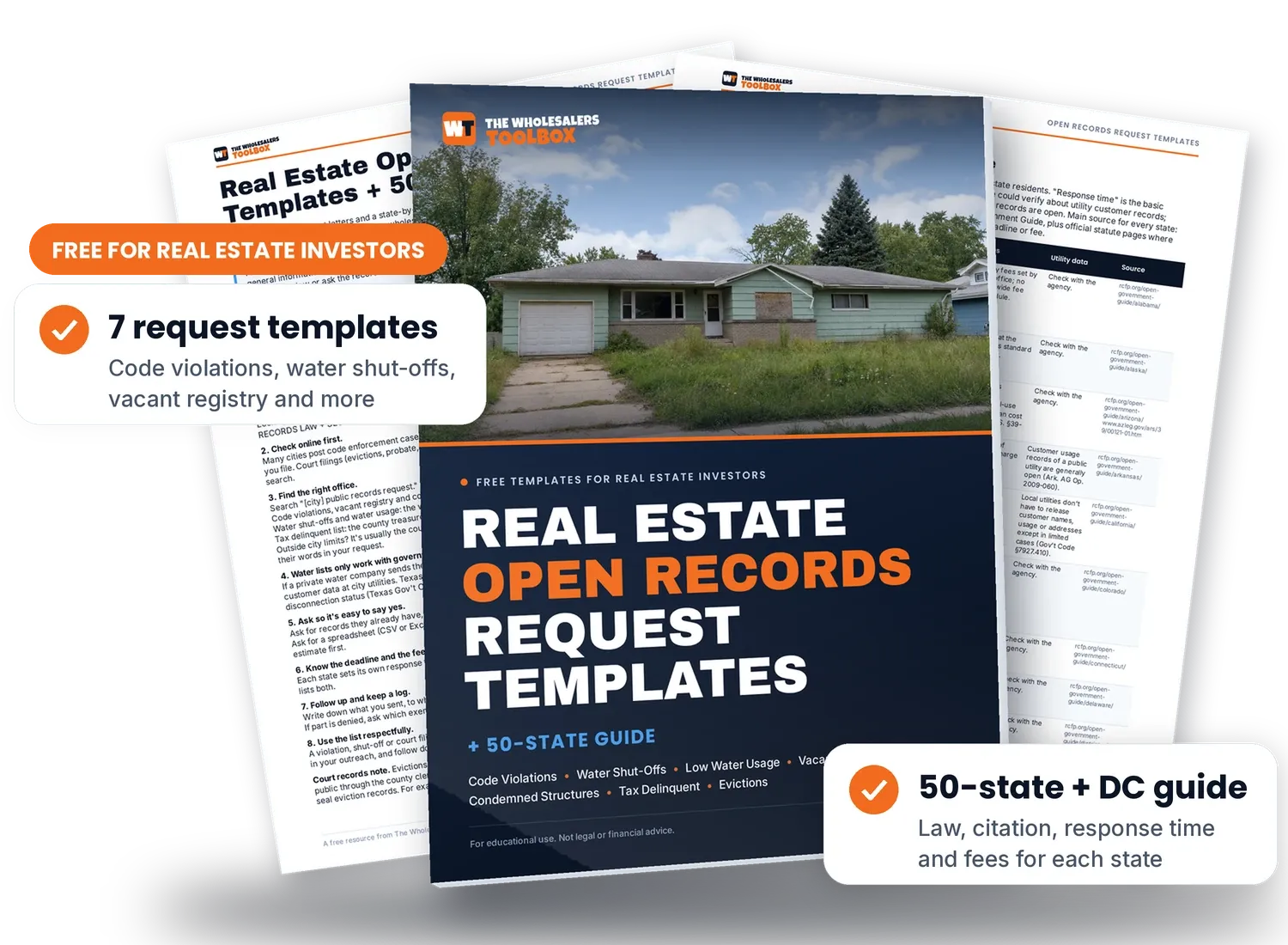
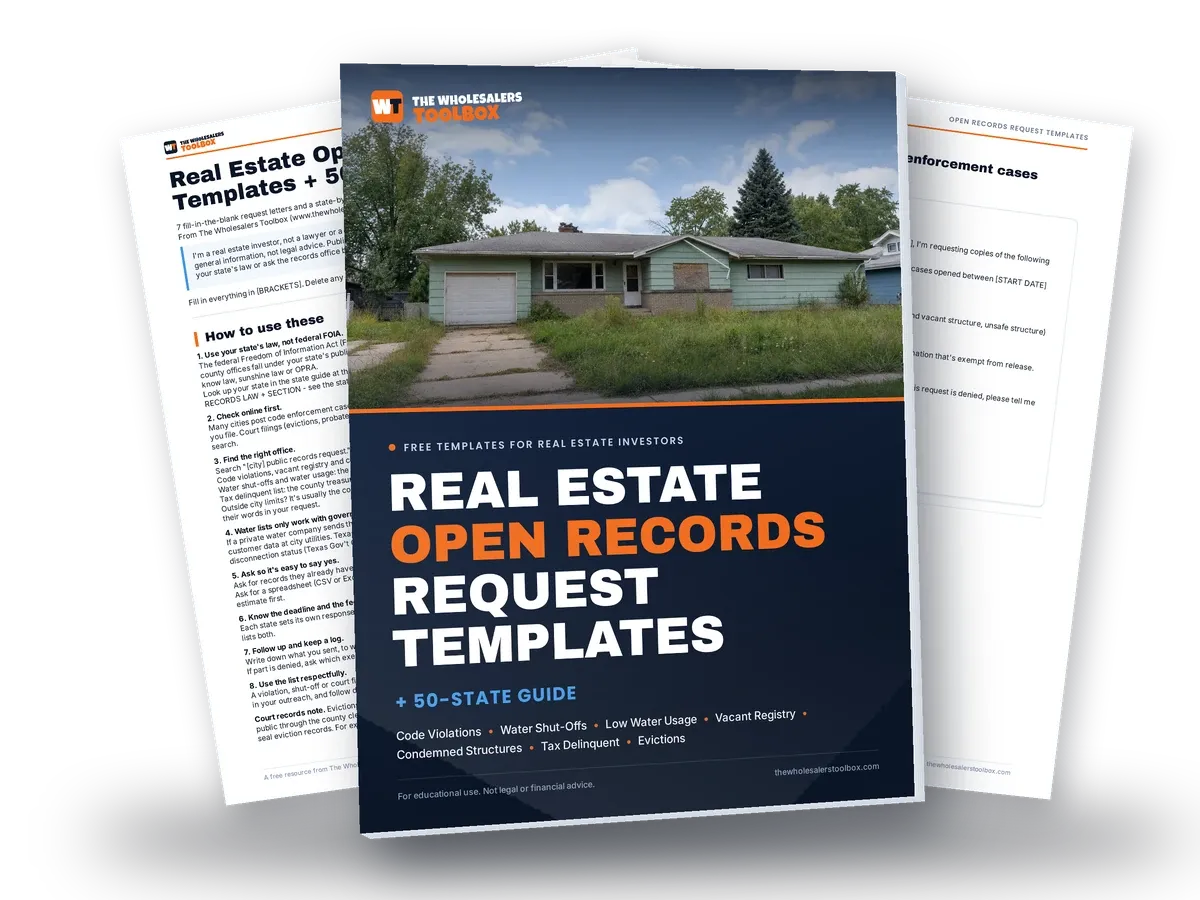
Real Estate Open Records Request Templates + 50-State Guide

PDF + Word. 7 fill-in-the-blank letters and a guide to every state's records law.

  • Code violation, water shut-off, vacant, condemned and tax delinquent letters
  • Clerk of court letter for eviction filings
  • 50-state + DC guide: law, deadline, fees and utility rules

For real estate investors. Free. Unsubscribe anytime.

Short answer

Ask your city or county for the list under your state's public records law (not federal FOIA). Code violations, vacant and condemned homes come from code enforcement or the building department. Water lists come from a government-run water utility. Tax delinquent lists come from the county treasurer. Eviction filings are court records you search on the clerk of court's website.

Law to useYour state's records law
Who to askCity or county records office
CostOften free or copy fees
WaitSet by your state

Which list, where to ask

6 public lists that can point you to motivated sellers

Each list lives in a different office. Start with the one your city is most likely to keep, then add more.

Code violations

Where to ask
Code enforcement, building or neighborhood services (city). County code office if you're outside city limits.
What you get
Address, parcel, violation type, open and close dates, fines or liens.
Tip
Check the city's open data portal first. Many post code cases for free.
Template 1 in the pack

Water shut-offs and low water usage

Where to ask
The city or county water utility, utility billing, or public works.
What you get
Service addresses with shut-off and restore dates, or zero or very low usage over several billing periods.
Tip
Only government or municipal water departments, not private water companies. Ask for a report they already run, like a disconnect or zero-usage report.
Templates 2 and 3 in the packGovernment water only

Vacant property registry

Where to ask
Code enforcement or the building department.
What you get
Registered vacant homes, date registered, status, responsible party.
Tip
Only cities with a vacant property ordinance keep one. Ask first.
Template 4 in the pack

Condemned or unsafe homes

Where to ask
The building department or code enforcement.
What you get
Condemned, unfit or demolition-list properties, order dates, liens.
Tip
Ask for board-up and demolition liens too.
Template 5 in the pack

Tax delinquent list

Where to ask
The county treasurer or tax collector.
What you get
Parcel, owner and mailing address, years and amount owed, status.
Tip
Many counties already post or sell this list. Check their site first.
Template 6 in the pack

Evictions and court filings

Where to ask
The county clerk of court, usually through its online case search.
What you get
Eviction, probate, divorce and foreclosure cases: case number, filing date, parties, address.
Tip
Search, don't request. Some states seal or limit eviction records. See court records below.
Template 7 in the packCourt record
Send me the templatesFree. Unsubscribe anytime.

Water lists only work with government-run water

Public records laws cover government offices. If a private water company sends the bills, it usually isn't covered, and it won't hand over shut-off or usage lists. Even city-run utilities can be off limits in some states.

  • Texas bars government-run utilities from releasing whether an account is delinquent or set for disconnection, plus advanced-meter usage and billing data (Texas Gov't Code §552.1331). Residential customer data is also limited by Texas Utilities Code §182.052. San Antonio Water System says it no longer releases shut-off lists.
  • Other states protect some utility customer details too. California, Kansas, Minnesota and Nebraska are examples. The free guide notes the rule we found for each state.

Before you send a water request, check who runs the water and look up your state.

Sources: SAWS open records, RCFP Open Government Guide (Texas).
FOIA vs. your state's law

“FOIA request” is the name everyone knows. It's usually not the right law.

This trips up a lot of investors (our old version of this page got it wrong too). Here's the simple version.

Federal FOIA

For federal agencies

The Freedom of Information Act lets you ask federal agencies, like HUD or the IRS, for their records. Agencies have 20 business days to respond.

  • Does not cover cities, counties or local utilities
  • Not where code, water or tax lists live
Your state's law

For your city, county and local utility

Every state has its own public records law. It may be called a public records act, open records act, right-to-know law, sunshine law or OPRA.

  • Covers the offices that keep motivated seller lists
  • Deadlines, fees and who can ask vary by state

No harm done if you've been saying FOIA. Most clerks know what you mean. Naming your state's law just makes your request clearer and shows you know the rules that apply. Examples: the Texas Public Information Act, Florida's Public Records Law, Pennsylvania's Right-to-Know Law and New Jersey's OPRA.

Inside the free 50-state guide

Every state has its own deadline

The basic response time in each state's law. Many allow extensions, and some count only business days. The guide gives the law name, section, who can ask, fees and utility rules for all 50 states plus DC.

  • 5 business days or less
  • 6 to 30 days
  • No set number of days (“promptly” or “reasonable time”)

Sample: 3 of 51 entries

StateLawWho can askResponse timeUtility data
FloridaFlorida Public Records Law
Fla. Stat. ch. 119
AnyoneNo set deadline - a "reasonable time."Records of city-owned utilities are public records; check exemptions with the utility.
TexasTexas Public Information Act
Tex. Gov't Code ch. 552
Anyone"Promptly"; to withhold, the agency must ask the Attorney General within 10 business days.Government-run utilities can't release delinquency, disconnection or usage data (Gov't Code §552.1331); customer data also limited by Utilities Code §182.052.
VirginiaVirginia Freedom of Information Act
Va. Code §2.2-3700 et seq.
Virginia citizens (and media serving Virginia)5 working days; 7 more if needed.Customer name, service address and account info can be withheld (not amounts billed and paid) (Va. Code §2.2-3705.7).
48 more states, fees and a source link for every entry are in the free guide.Send me the guide

Court records

Evictions, probate, divorce and foreclosures: search, don't request

These filings are court records, not city records. They're usually public through your county clerk of court's online case search, so you don't need an open records request.

Where to look

  • Search “[your county] clerk of court case search.”
  • Filter by case type: eviction (landlord-tenant), probate, divorce, or foreclosure. Foreclosures often start with a lis pendens filed with the county.
  • Some clerks sell bulk data or daily filing reports. Ask about cost.
  • Template 7 in the pack is a short letter to the clerk if you can't find a search tool.

Some states limit eviction records

  • California limits public access to most eviction case files for the first 60 days (Code Civ. Proc. §1161.2).
  • Minnesota requires courts to expunge some eviction cases (Minn. Stat. §484.014).
  • Washington courts can limit who sees an eviction case (RCW 59.18.367).
  • Other states have their own rules, so check with your clerk.

Step by step

How to request a list from your city

  1. Check for a free online list first

    Search “[your city] open data code enforcement.” Many cities post code cases you can download. Court filings are usually on the county clerk's online case search.

  2. Find the right office

    Search “[your city] public records request.” Use the city's online portal if it has one. If not, email the city clerk and ask which department keeps the record.

  3. Call and ask what the record is called

    Be friendly. Ask what the report is called in their system, like “code case export” or “disconnect report.” Use their words in your request.

  4. Name your state's law, not federal FOIA

    Look up your state's public records law and section, then put it in the letter. The free guide lists every state.

  5. Ask for records they already have

    Name the fields and the date range. Ask for a spreadsheet. Say you don't want exempt details, so they can release the rest.

  6. Ask for a cost estimate first

    Fees vary by state and agency. Ask them to tell you the cost before they start.

  7. Log it and follow up on time

    Write down the date, office and any reference number. If the state deadline passes, send a short, polite follow-up.

  8. Check the owner and reach out kindly

    A violation or shut-off doesn't mean someone wants to sell. Look up the owner in county records and follow do-not-call and marketing rules.

The open records request templates pack: 7 request templates and a 50-state + DC guide

What's in the free pack

7 letters, a state guide and a tracking log

  1. Code violations request
  2. Water shut-offs request
  3. Low or zero water usage request
  4. Vacant property registry request
  5. Condemned or unsafe homes request
  6. Tax delinquent list request
  7. Eviction filings letter to the clerk of court

Plus a one-page how-to, a follow-up letter, a request log, and the 50-state + DC guide. PDF and Word.

Send me the templatesFree. Unsubscribe anytime.

FAQ

Common questions

Can I use a FOIA request to get code violation lists from my city?

Not under federal FOIA. The federal Freedom of Information Act only covers federal agencies. Your city, county and local water utility follow your state's public records law, so name that law in your request. Many clerks will still help if you write “FOIA,” but naming the right law is clearer.

What is a code violation list?

It's a list of properties the city has cited for problems like tall grass, trash, open or vacant structures, or unsafe conditions. Investors use it to find owners who may be dealing with a run-down house.

Are water shut-off lists public records?

Sometimes. They only fall under public records laws when the water utility is run by the government, not a private company. Some states also protect utility customer data. Texas, for example, bars government-run utilities from releasing whether an account is delinquent or set for disconnection.

How much does an open records request cost?

Often nothing or just copy costs, but it depends on your state and the agency. Some charge for staff time on big requests. Ask for a cost estimate before they start, and ask for an electronic file, which is usually cheaper than paper.

How long does an open records request take?

Each state sets its own deadline. Some states give agencies 3 to 5 business days to respond, others 10 to 15 days or more, and some just say “promptly.” Many allow extensions for large requests.

Do I have to say why I want the records?

Usually not. In most states you don't have to explain why. Some states treat commercial requests differently, though. Kentucky, for example, can charge more for records used for a commercial purpose.

Can I get eviction filings with an open records request?

Usually you search for them instead. Evictions, probate, divorce and foreclosure filings are court records, so they're normally on the county clerk of court's online case search. Some states limit or seal eviction records.

Can I request records from a city in another state?

In most states, yes. A few limit their law to their own residents or citizens, including Alabama, Arkansas, Delaware, Tennessee and Virginia. The state guide shows who can ask in each state.

Real Estate Open Records Request Templates + 50-State Guide, PDF and Word

Free for real estate investors

Get the 7 templates and the 50-state guide

Fill in the blanks, name your state's law, and send. PDF and Word.

Send me the templatesFree. Unsubscribe anytime.

About David

David Frizzell is a real estate investor who runs The Wholesalers Toolbox, a free set of tools and guides for wholesalers. He isn't a lawyer or a licensed real estate agent. More about David.

Keep building your list