Wholesaling University · Lesson 9 of 19

How to calculate ARV (after repair value) for wholesaling

Pick the right sold comps, adjust for the differences, and land on a value your cash buyers will agree with.

Module 4: Running the numbersAbout 11 min readFree course
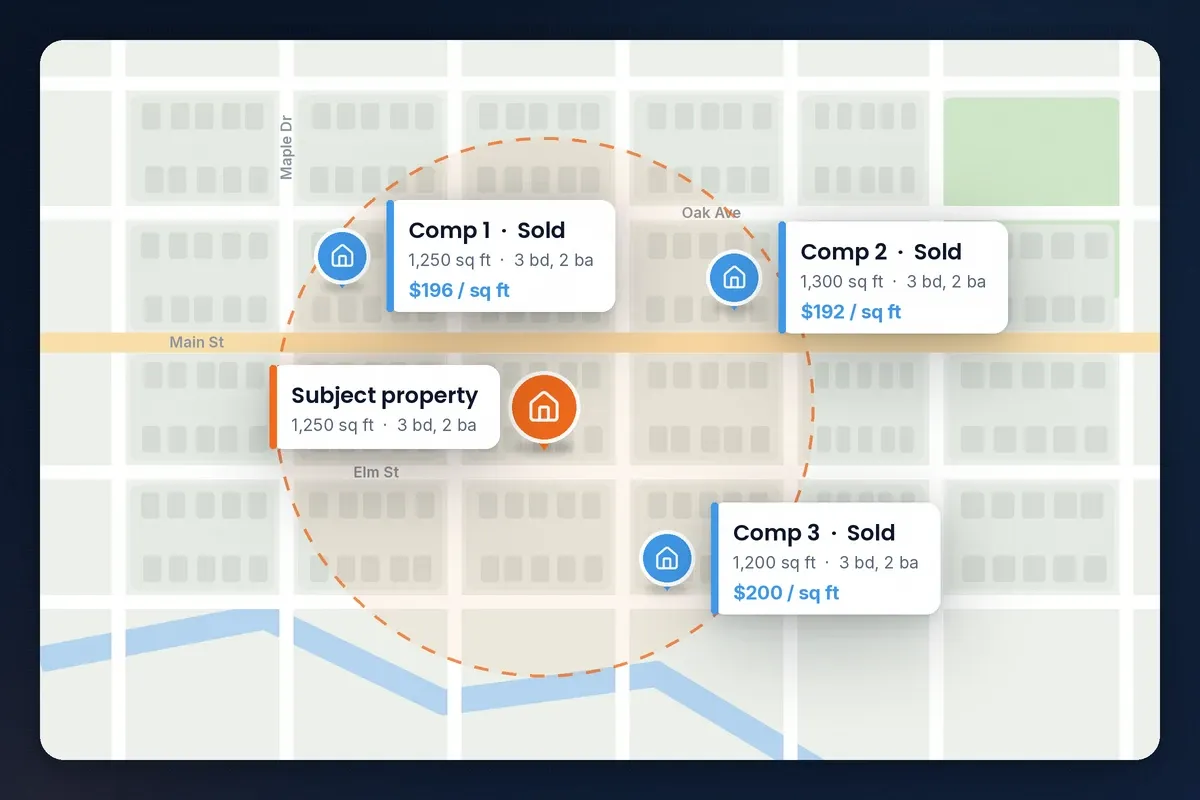
Map with a subject house and three nearby sold comps labeled with price per square foot
Quick answer

ARV, or after repair value, is what a house should sell for once it's fully fixed up. To calculate it, find 3 to 5 renovated homes nearby that sold in the last 3 to 6 months and are close in size, beds, baths and age. Average their price per square foot, then multiply by your house's square footage.

Lesson
9 of 19, module 4: Running the numbers
Time
About 11 minutes to read
Formula
Average sold price per sq ft x subject sq ft
Free tool
Wholesale Deal Analyzer (Excel)
The basics

What ARV is, and why your offer starts here

The after repair value (ARV) is an estimate of what a distressed house will be worth after an investor makes all the needed repairs. It's not what the house is worth today, and it's not what the seller wants. It's what a fixed-up version of it would sell for.

Every number after this one depends on it. Your maximum allowable offer starts with ARV, and so does your buyer's profit. Get the ARV wrong by a little and the whole deal can fall apart at closing.

Agents do this with a CMA (comparative market analysis), which most people call pulling comps. You don't need MLS access to get a solid number. Public sold data on the big listing sites is good enough to start, as long as you pick the comps carefully.

Subject property

The house you're thinking of putting under contract.

Comps

Comparable homes nearby that sold recently. For ARV, you want the renovated ones.

Price per sq ft

Sold price divided by living area. It lets you compare houses of different sizes.

AVM

An automated valuation model, like a Zestimate. A starting point, never your ARV.

Step by step

How to calculate ARV, step by step

Step 1: Get the facts on the subject property

Before you look at a single comp, write down the basics on your house: living area in square feet, beds, baths, year built, lot size, garage, pool and the style (ranch, two-story and so on).

Pull them from the county property appraiser site or a listing site, then confirm them at the walk-through. Square footage that's off by a few hundred feet throws off everything.

Checklist
  • Living area (sq ft)
  • Beds, baths, year built
  • Lot, garage, pool, style
  • Current condition noted

Step 2: Pull sold comps nearby

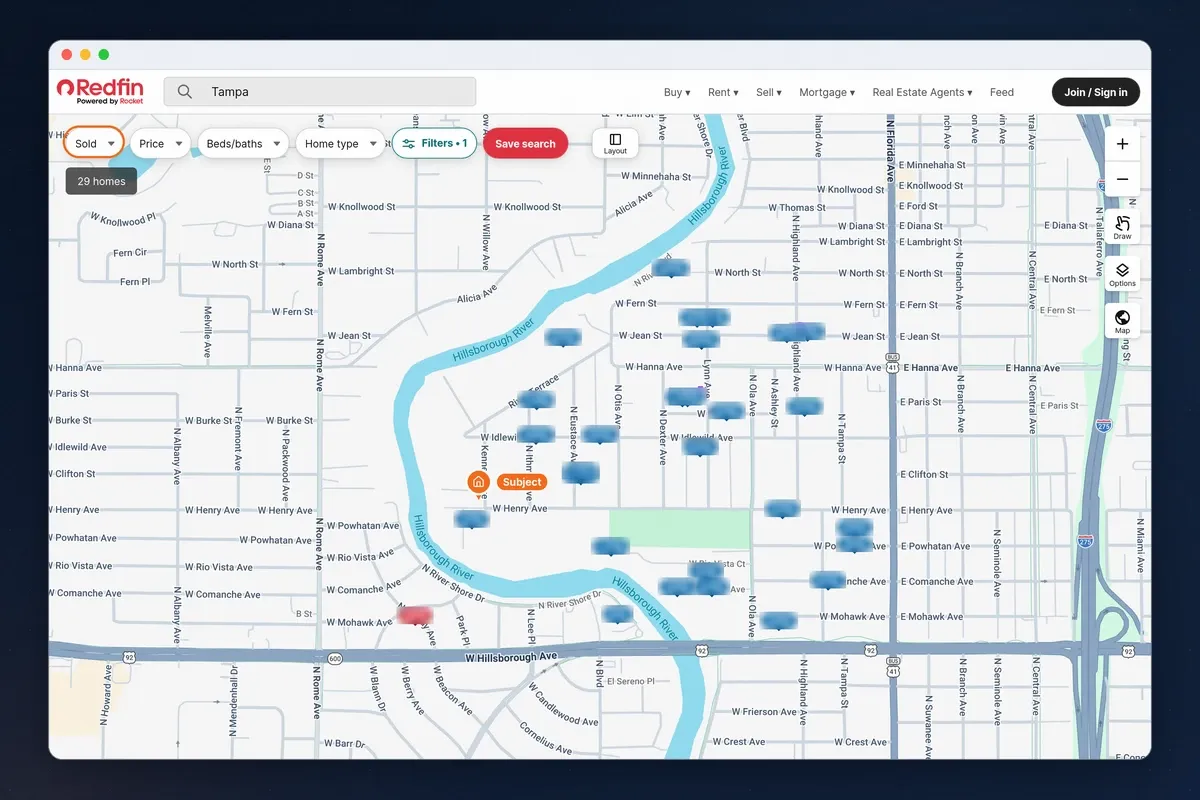
On Zillow, Redfin or Realtor.com, search the address, switch the map to Sold (on Zillow it's the "Sold" listing type filter) and zoom in around your house. You're looking for homes that sold, not ones that are listed.

Start tight and widen only if you have to: same neighborhood first, then about half a mile, then a mile. Sold in the last 3 to 6 months. Same property type, within about 20% of your square footage, similar beds and baths.

A good comp is
  • Sold in the last 3 to 6 months
  • Within about half a mile, same neighborhood if possible
  • Same type, within about 20% of the square footage
  • Similar beds, baths and age
  • Updated or renovated (photos show it)
Listing-site map switched to sold homes around a subject property

Step 3: Keep the best 3 to 5 renovated comps

Open the photos for every sold home on your list. Keep the ones that were fixed up: new kitchen, new floors, fresh paint. Those show what your house could sell for after repairs. Toss the ones that sold as-is, because they show today's value, not ARV.

Also toss anything odd: a sale between family members, a house on a busy road when yours isn't, or a sale far above or below everything else.

Checklist
  • 3 to 5 renovated sold comps
  • No family sales, foreclosures or outliers
  • Busy roads, water and school lines noted

Step 4: Adjust for the big differences

No two houses are the same. If a comp has an extra bedroom, a garage or a pool and yours doesn't, it probably sold for a bit more. Nudge its value down in your head, or drop it if the difference is big.

Keep it simple. You're not an appraiser and you don't need to be. You need a number that's close and that you can explain to a buyer.

Checklist
  • Extra bed or bath
  • Garage, pool, big lot
  • Much newer or older

Step 5: Average the price per square foot

Divide each comp's sold price by its living area to get price per square foot. Average those numbers, then multiply by your house's square footage.

Then look at it a second way: what's the middle sold price of your comps? If the two numbers are far apart, one of your comps is probably off.

ARV = average sold price per sq ft of your comps x subject sq ft

Step 6: Sanity check the number

Compare your ARV with the online estimates, active and pending renovated listings nearby, and what your cash buyers tell you. Zillow, Redfin and the others build their estimates from public records with automated models. They're useful, but they don't know the house needs a roof.

Ask one or two of your buyers what they think a fixed-up version would sell for. They know their market, and if they disagree with your ARV, you'll find out now instead of after you sign.

Checklist
  • Online estimates checked
  • Active and pending renovated listings checked
  • One buyer asked

Step 7: Round down and write it down

When in doubt, use the lower number. A conservative ARV protects your buyer and your deal. Save your comps (addresses, sold dates, prices, links) with the deal. Your buyers will ask, and showing your work builds trust.

Next, estimate the repairs (lesson 11) and run your maximum allowable offer.

Examples

Worked example

Made-up numbers to show the math. Your market will be different, so run your own comps.

Example

ARV from 3 renovated comps

Subject: 3 bed, 2 bath ranch, 1,400 sq ft, needs a full cosmetic rehab.

CompSq ftSold pricePrice per sq ft
Comp A (renovated, 0.3 mi)1,350$189,000$140
Comp B (renovated, 0.4 mi)1,500$205,500$137
Comp C (renovated, 0.6 mi)1,420$201,640$142
Average$139.67

$139.67 x 1,400 sq ft = $195,533. Rounded down, this example ARV is $195,000. The middle sold price ($201,640) is close, so the comps agree.

Example

Why the as-is sales don't count

Say a fourth house on the same street sold for $128,000 with its original kitchen and old carpet. That sale shows what a house like yours is worth today, before repairs. Put it in the ARV average and you'd pull this example ARV down by thousands, and your offer with it.

Avoid these

Mistakes to avoid

Using the Zestimate as your ARV

Online estimates are a starting point. They can't see the condition or the upgrades.

Mixing in as-is sales

Unrenovated sales show today's value. ARV needs fixed-up comps.

Going too far for comps

A mile in the suburbs can be fine. A mile in a city can be a different market.

Using old sales

Prices move. Stick to the last 3 to 6 months, and say so when you have to go further.

Comparing different houses

A two-story with a garage isn't a comp for a small ranch without one.

Rounding up

Hope isn't a strategy. Round down and let your buyer be pleasantly surprised.

Recap

Lesson recap

  • ARV is what the house should sell for after repairs, not what it's worth today.
  • Use 3 to 5 renovated sold comps: close by, recent, similar in size and type.
  • Average the price per square foot and multiply by your square footage.
  • Check it against online estimates, listings and your buyers, then round down.

Check your state. Wholesaling laws vary by state, including how you can market a contract and what you have to disclose. Read your state's rules, and ask a local real estate attorney if you're not sure.

See the whole Wholesaling University course free

Enter your name and email to read the rest of this lesson and every lesson in the course.

  • The full text of every lesson, opened on this device
  • Every step, worked example and checklist
  • My free Wholesale Deal Analyzer (Excel)

Free. No credit card. Unsubscribe anytime.

Unlocked. You're signed up, so every Wholesaling University lesson is open in full on this device.
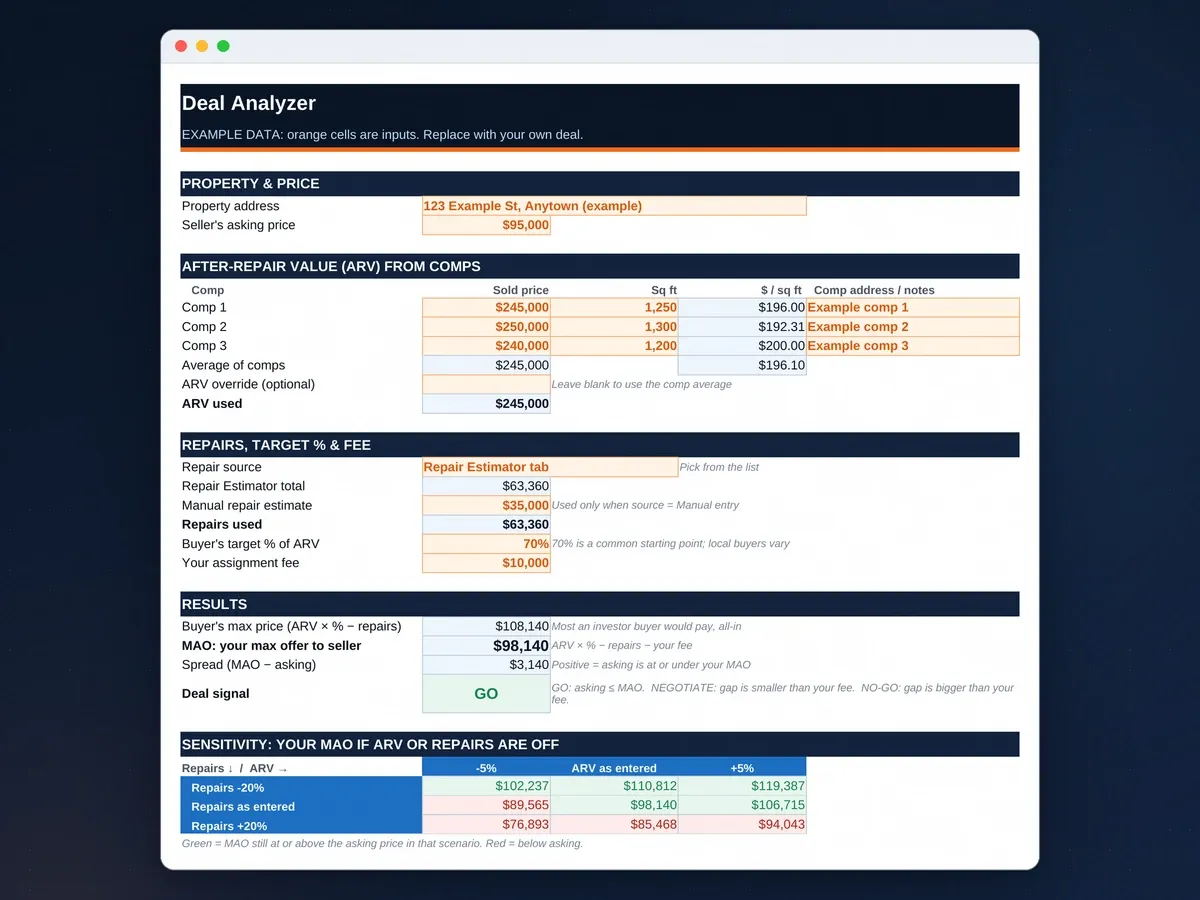
Excel Deal Analyzer tab showing the maximum allowable offer box
Free tool

Run these numbers in my free Wholesale Deal Analyzer

An Excel workbook that takes you from comps to ARV, repairs and your maximum allowable offer in one sheet. Free.

  • Averages up to 3 sold comps into an ARV, with price per square foot
  • Repair estimator with 19 line items
  • MAO = ARV x your buyer's % - repairs - your fee, with a go, negotiate or no-go signal
  • A buyer view and a rental view of the same deal
Get the free Deal Analyzer
FAQ

Lesson 9 FAQ

What does ARV mean in real estate?

ARV stands for after repair value. It's the estimated price a property should sell for after all the needed repairs are done. Wholesalers and flippers use it as the starting point for every offer, because the buyer's profit and your maximum allowable offer both come from it.

How do I find ARV on Zillow?

Search the address, then switch the map to sold homes and zoom in around the property. Open the homes that sold in the last 3 to 6 months, keep the renovated ones that are close in size, beds and baths, and average their price per square foot. Multiply that by your house's square footage.

Is the Zestimate the same as ARV?

No. A Zestimate is an automated estimate of what a home is worth now, based on public records and recent sales. It doesn't know the condition of the house. ARV is what the house should sell for after repairs, so you build it from renovated sold comps.

How many comps do I need to calculate ARV?

Three to five good comps is plenty. Three renovated homes that sold recently, close by and similar in size will give you a better ARV than ten that don't match. If you can only find one or two, widen the search carefully and use a more conservative number.

How far back should comps go?

Try for sales in the last 3 to 6 months, because prices change. In slow or rural markets you may need to go back further or wider. When you do, be more conservative with your ARV and tell your buyers how old the comps are.

Is there a free after repair value calculator?

Yes. My free Wholesale Deal Analyzer is an Excel workbook that averages up to 3 sold comps into an ARV, shows the price per square foot, and carries the ARV straight into your maximum allowable offer. It opens in Excel and is built to work in Google Sheets too.

Does ARV include the cost of repairs?

No. ARV is the value after the repairs are done. The repair cost is a separate number you subtract when you calculate your maximum allowable offer. That's why rehab costs (lesson 11) and MAO (lesson 12) come next in the course.

Next: lesson 10, Property walk-through checklist

What to look at, photograph and ask when you walk a house with the seller.

Heads up: I earn a commission if you buy through my link. Costs you nothing extra, but it helps fund my Starbucks addiction. ☕

Not financial or legal advice. Wholesaling University is for education. David Frizzell is a real estate wholesaler, not an attorney or financial advisor. Wholesaling laws vary by state, so check the rules in your state before you market a property or make offers, and talk to a local real estate attorney if you're not sure.

Free download

Free wholesaling contract pack

Wholesaling contract templates, free. Enter your email and the pack lands in your inbox.

Free. Unsubscribe anytime. After you sign up I'll open DealMachine in a new tab.